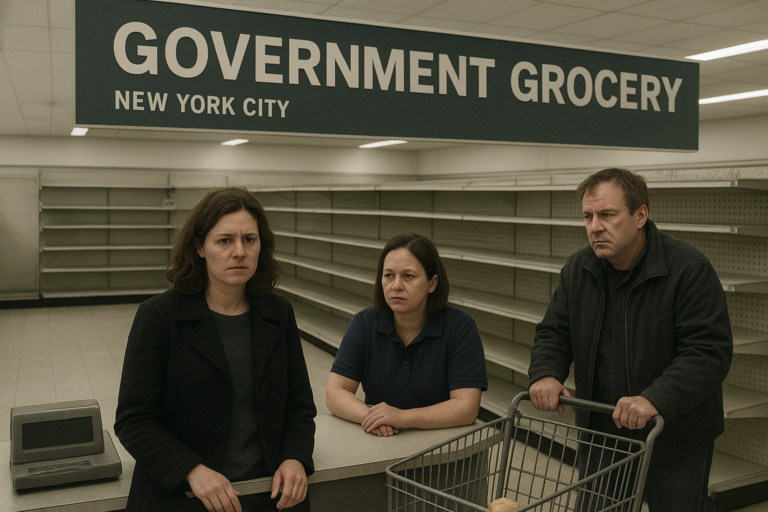
We, the undersigned New Yorkers, urge you to reject proposals to open government-owned grocery stores in New York City and instead focus on real solutions where the need is greatest—NYC’s true food-access deserts—and on strengthening existing, locally owned and union grocery jobs.
Why we oppose city-run grocery stores
- They’ve failed elsewhere—often after heavy subsidies—while harming the private market. Kansas City’s publicly backed Sun Fresh received many millions in public support and still collapsed amid empty shelves and losses approaching ~$900,000/year before closing in August 2025.
- Rural prototypes don’t translate to NYC’s complex market. Baldwin, Florida’s town-run “Baldwin Market” couldn’t break even and shut down in 2024; Erie, Kansas purchased its only grocery but ultimately had to lease it out to a private operator because the city couldn’t sustain operations.
- The current NYC proposal is thin on operations and risks crowd-out. Public briefings to date describe a five-store pilot (one per borough) with tens of millions in public costs but few details on supply chain, shrink/theft management, or how the City would avoid undercutting existing neighborhood grocers—many of which are union-represented.
Protect union grocery jobs & neighborhood stores
- NYC’s grocery workforce includes thousands of union jobs—UFCW Local 1500 and RWDSU/Local 338 members at Stop & Shop, ShopRite, Key Food, Gristedes, Fairway, Zabar’s and more—providing negotiated wages, health care, pensions, and scheduling protections. City-run stores that sell below cost or sit on subsidized real estate threaten these jobs and the stores that provide them.
Our ASK
- Reject any plan to create government-owned/operated grocery stores. Instead, publish an NYC Grocery Access Action Plan that:
- Directs incentives and capital to high-insecurity NTAs first (South Bronx, Central Brooklyn, etc.).
- Reforms FRESH: require affordability benchmarks, SNAP/WIC acceptance, clear timelines to open, claw-backs for non-delivery, and labor standards that favor union employers.
- Stabilizes and expands union grocers through security grants (to reduce theft/shrink), energy-efficiency upgrades, and targeted rent/operational relief tied to maintaining union jobs.
- Publish site-selection criteria that prevent subsidized competition directly across from viable union supermarkets and prioritize underserved areas with limited full-line grocery access.
- Strengthen community food networks (food co-ops, mobile markets, culturally responsive grocers) with support for cold-chain equipment, insurance, and permitting—delivered via private/community operators, not City-run stores.
We stand with New York’s union grocery workers and local owners. Don’t risk a publicly run experiment that has struggled elsewhere. Invest in the neighborhoods with the highest need, and in the private and union operators who already serve New Yorkers every day.
Fix what isn’t working—and scale what does—instead
- FRESH needs reform, not replacement. NYC’s FRESH program offers zoning and tax incentives to bring supermarkets to low-access areas. The City Comptroller found the program is small (about $3–4M/year in benefits) with modest, uneven impact and limited wage/union tracking—meaning it sometimes benefits developers without guaranteeing strong labor standards or meaningful neighborhood access. Strengthen it: tie benefits to affordability, SNAP/WIC acceptance, and union/job-quality metrics; stop deals that leave space empty.
- Target the real deserts. City Council data show food insecurity rates topping 30% in several (Neighborhood Tabulation Areas) NTAs (e.g., West Farms, Belmont, Highbridge, Mott Haven). Public dollars should prioritize these neighborhoods with a mix of private-operator grocery incentives, secure-perimeter bodega upgrades, and last-mile food-access investments—not launch city-owned chains.
- Address affordability pressures directly. Food costs in the NYC metro rose 56% over the past decade—outpacing national trends—worsening household food insecurity. Helping families afford food (EBT modernization, produce credits, delivery fee relief for SNAP) will do more than the City trying to run supermarkets.